



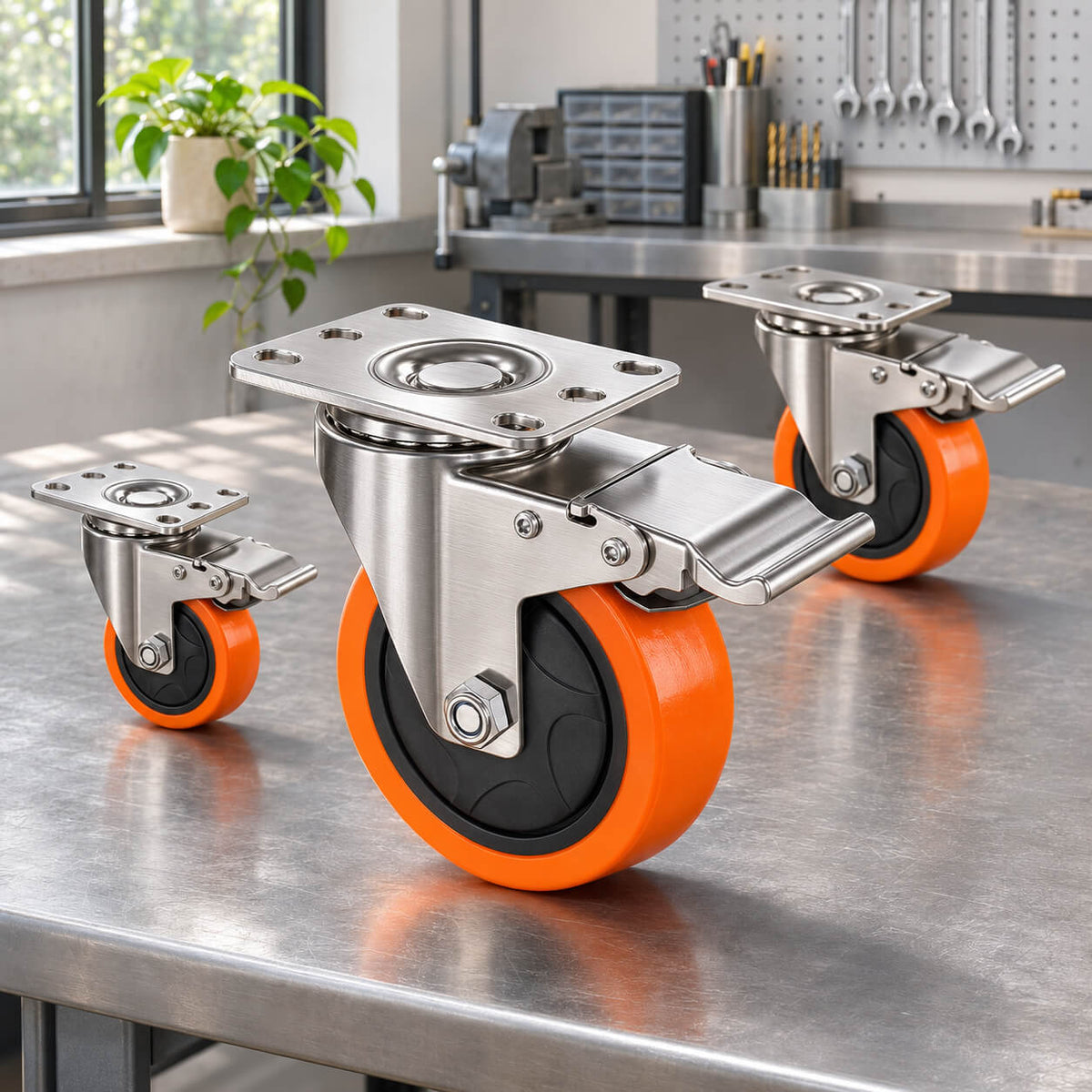
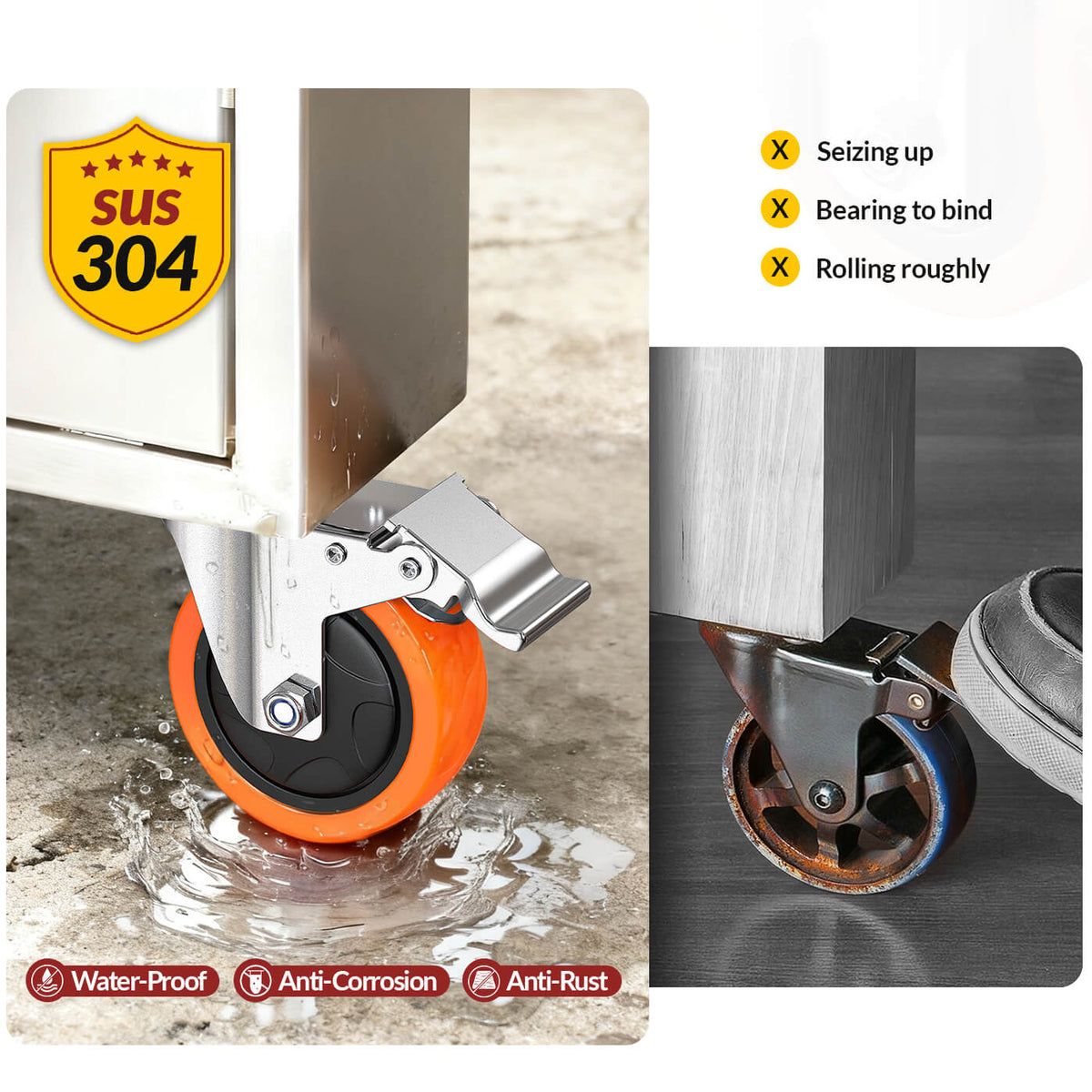
A total lock caster is a swivel caster with a mechanism that locks both the wheel and the swivel head. When engaged, it stops the wheel from rolling and the caster fork from pivoting. This helps control unwanted movement when a cart, cabinet, or workbench is parked.
Understanding those two movements makes it easier to choose the right locking casters for your equipment, especially when a set combines swivel and rigid casters.
How Does a Total Lock Caster Work?
A swivel caster moves in two ways:
- The wheel rotates around its axle, allowing the equipment to roll.
- The fork turns around the swivel axis, allowing the wheel to change direction.
A total-lock mechanism secures both movements. On a foot-operated model, engaging the pedal activates the wheel brake and the swivel lock. Releasing it restores rolling and steering.
The pedal's exact design varies by model. When reviewing a product, look for an explicit statement that it locks both the wheel and the swivel. A brake pedal alone does not identify which movements are controlled.
Total Lock, Wheel Brake, and Directional Lock
These terms describe different functions. The table below shows what each mechanism controls when engaged.
| Mechanism | Stops wheel rotation? | Stops swivel movement? |
|---|---|---|
| Wheel-only brake | Yes | No |
| Directional lock alone | No | Yes, at specified positions |
| Total lock | Yes | Yes |
A directional lock helps a swivel caster follow a selected direction while the wheel continues to roll. A total lock is used to secure both movements when the equipment is parked.
For a closer look at the brake options, read our Total Lock vs. Wheel Brake guide.
Where Are Total Lock Casters Useful?
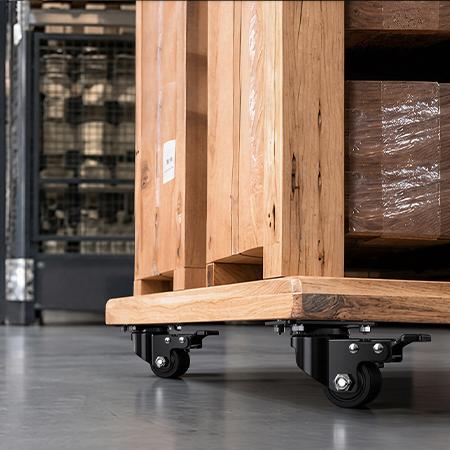
Consider the way equipment is used between moves. A tool cabinet may roll across a workshop, then stay beside a work area while tools are selected. A parts cart may travel between stations, then remain positioned while its contents are sorted. A mobile workbench may need occasional repositioning during layout changes.
In these situations, controlling both rolling and swiveling can be useful. The choice still depends on the complete equipment setup: its weight, frame, mounting points, floor, and the forces applied during use. Caster locks provide parking control; equipment that needs leveling or anchoring requires those functions to be considered separately.
How Do Total-Lock Swivels Work With Rigid Casters?
A caster set can combine different functions. One example is two total-lock swivel casters and two rigid casters.
During travel, the swivel casters provide steering while the rigid casters help the equipment track along a consistent direction. At the destination, the total locks on the two swivel casters control their rolling and pivoting.
The rigid casters have fixed forks, but their wheels still roll. In HOLKIE's mixed PU plate caster set, the rigid casters do not have brakes. The set therefore contains two locking casters, with parking performance depending on the assembled equipment and its operating conditions.
This layout suits equipment that needs guided travel. If your equipment must also move directly sideways in confined spaces, compare the maneuvering requirements of a four-swivel layout before choosing.
What Should You Check Before Choosing a Set?
Start with the loaded equipment weight. Include the cart or cabinet itself, plus everything it carries. Check whether the published capacity applies to one caster or the complete set, and allow a suitable margin for uneven loading and operating conditions.
Match the mounting dimensions. For plate casters, compare the plate size, mounting-slot dimensions, and hole spacing with your equipment. Swivel and rigid versions can have different mounting patterns even within the same wheel size.
Allow room for the wheel, fork, and pedal. Confirm the overall installation height and the space needed for the caster to swivel. Position the equipment so the locking pedals remain accessible.
Match the tread to the floor. Wheel material affects rolling behavior and floor contact independently of the lock. For HOLKIE's PU plate caster set, plan around smooth, firm floors and keep the tread free of trapped debris.
A HOLKIE Example: Two Total-Lock Swivels and Two Rigid Casters
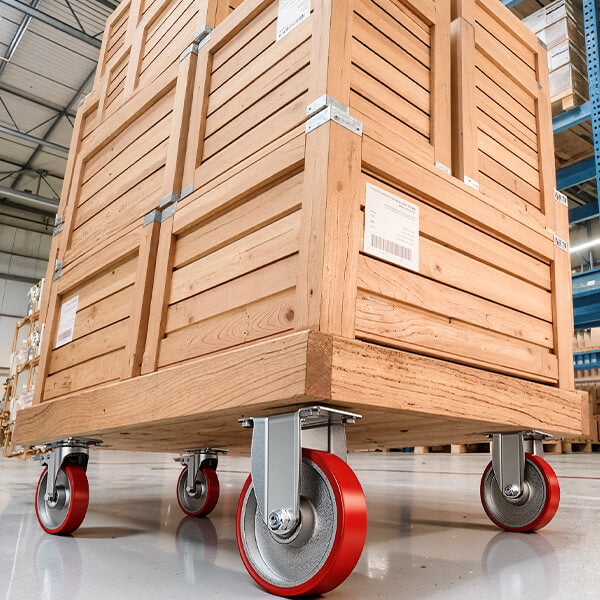
HOLKIE's heavy-duty PU plate caster set combines red polyurethane treads, cast iron wheel cores, double sealed ball bearings, and zinc-plated steel brackets.
Both size options include two swivel casters with foot-operated total locks and two rigid casters without brakes:
| Wheel size | Listed capacity per set of four |
|---|---|
| 3 inch | Up to 1,410 lb |
| 4 inch | Up to 1,984 lb |
These are complete-set ratings with evenly distributed weight. A mounting kit is included.
Compare the dimensions and options on the HOLKIE heavy-duty PU plate caster set. For help choosing between sizes, see our 3 inch vs. 4 inch heavy-duty caster guide.
Frequently Asked Questions
Does total lock mean every caster in the package has a brake?
Total lock describes the mechanism on an individual caster. Check the package configuration to confirm how many casters have it. HOLKIE's mixed set includes two total-lock swivel casters and two rigid casters without brakes.
Is a rigid caster already locked?
A rigid caster has a fixed fork, so it does not swivel. Its wheel can still roll unless the caster also has a separate wheel brake.
Does a total lock increase load capacity?
The lock controls movement. Select the caster using its published load rating; engaging a total lock does not increase that rating.
Can total lock casters level a workbench?
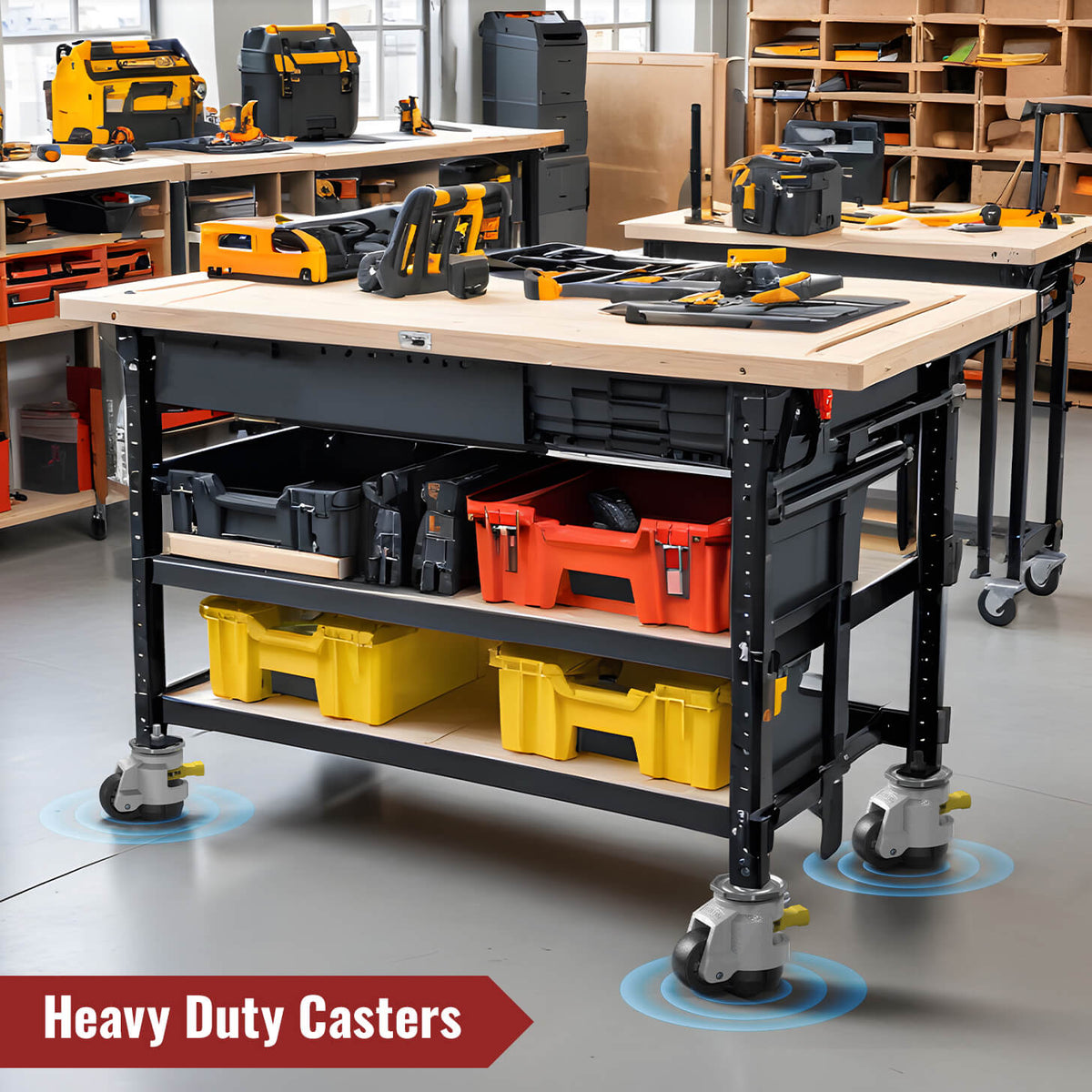
A total-lock mechanism controls wheel and swivel movement. Height adjustment requires a product with a separate leveling function. This HOLKIE PU plate caster set has no leveling adjustment.

Leveling Casters for Medical Equipment: How They Improve Stability