


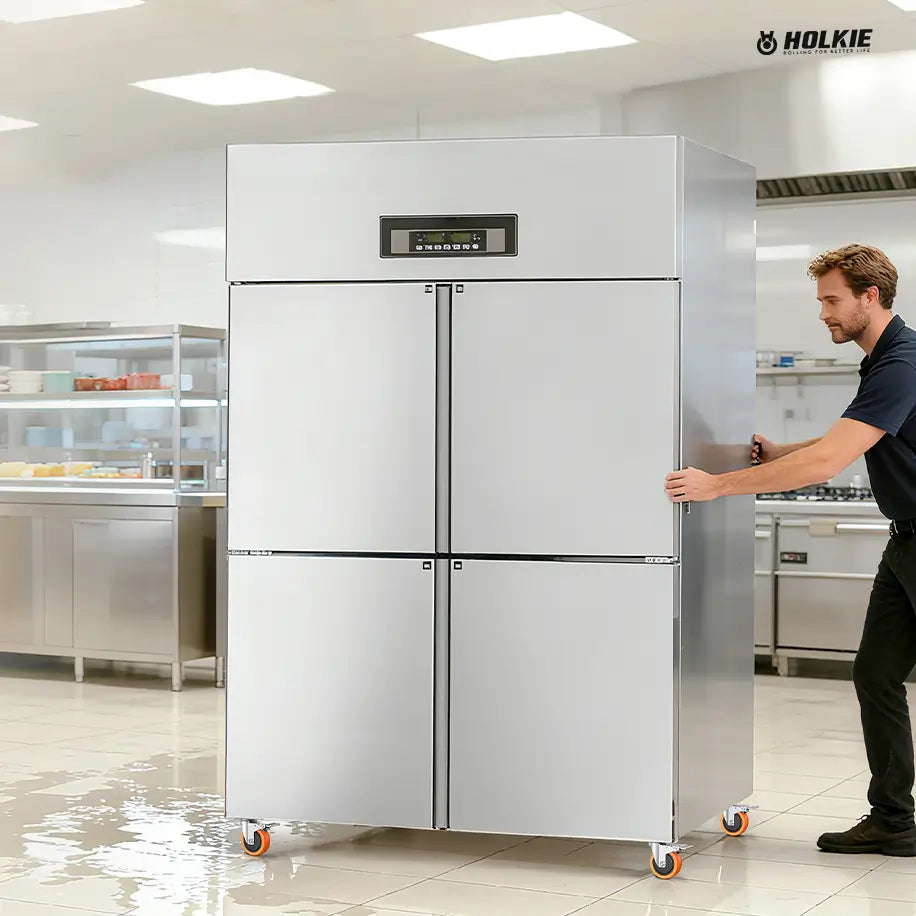
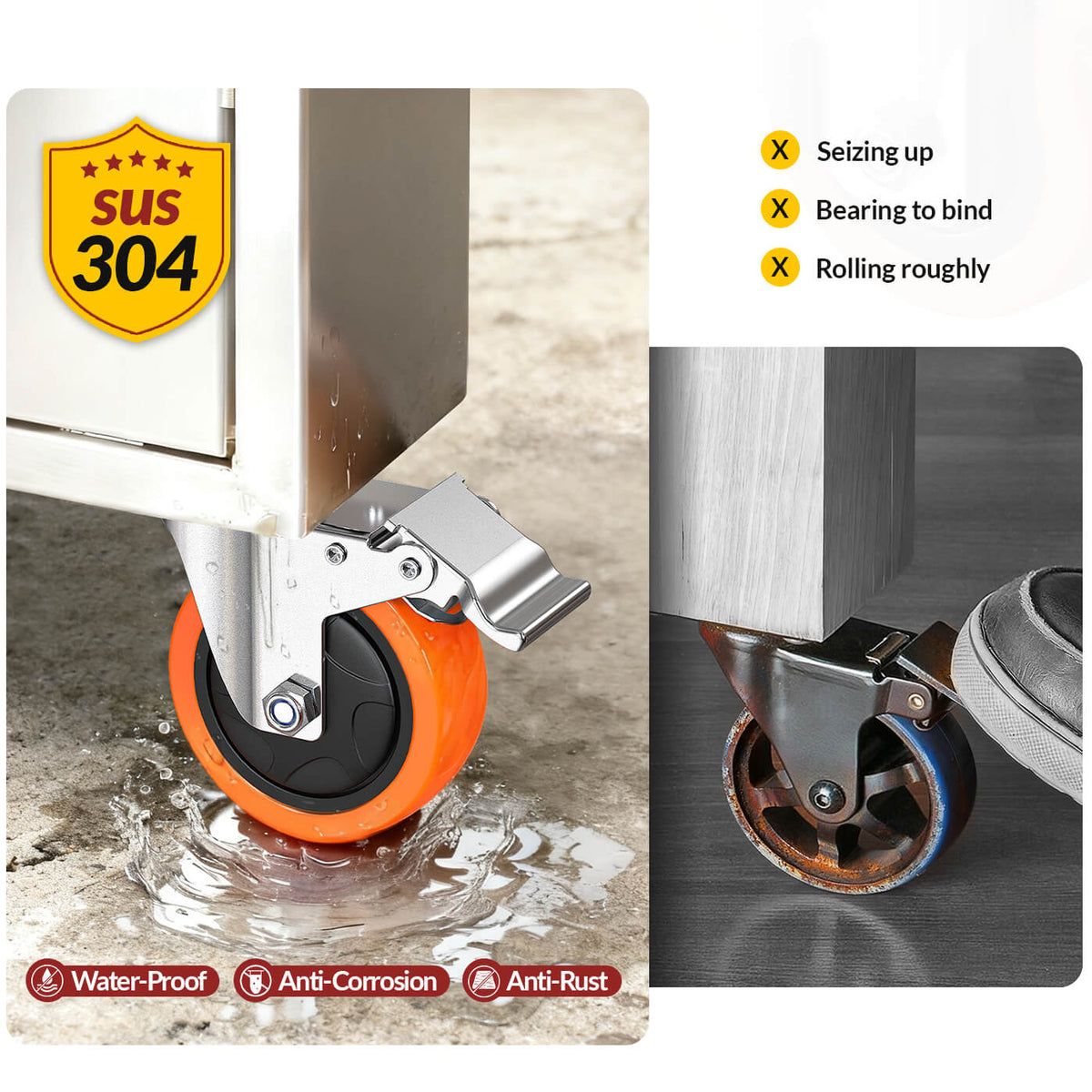
The main difference between 304 stainless steel casters and zinc-plated steel casters is how their metal brackets resist corrosion. A 304 stainless steel bracket is made from a corrosion-resistant steel alloy, while a zinc-plated bracket uses a protective zinc coating over steel.
Both can be useful, but the better choice depends on moisture, cleaning, floor conditions, load, and budget. Here’s how to compare them for your cart, table, or workbench.
What Are 304 Stainless Steel Casters?
A 304 stainless steel caster has components made from grade 304 stainless steel. In many products, this refers to the caster bracket that supports the wheel and attaches to the equipment.
Stainless steel contains chromium, which helps form a thin protective layer on its surface. This layer contributes to the material’s corrosion resistance and can reform after minor surface damage when sufficient oxygen is present.
A 304 stainless steel bracket is often considered when equipment will be used in a damp area or where corrosion resistance is a priority. However, its suitability still depends on the actual environment, including cleaning chemicals, salt exposure, temperature, and maintenance.
Check which components are stainless steel. A caster can have a 304 stainless steel bracket while its wheel, axle, brake, or mounting hardware uses a different material.
What Are Zinc-Plated Steel Casters?
A zinc-plated caster typically has a steel bracket with a layer of zinc applied to its surface. The zinc coating helps protect the underlying steel from corrosion.
The coating’s performance depends on factors such as its thickness, condition, and exposure. Zinc can also provide some protection around small damaged areas, but the amount of protection depends on the circumstances.
Zinc-plated casters may be a practical choice for general indoor equipment when their coating, load rating, wheel material, and mounting style suit the application.
304 Stainless Steel vs. Zinc-Plated Steel Casters
| Comparison | 304 stainless steel bracket | Zinc-plated steel bracket |
|---|---|---|
| Bracket construction | Made from 304 stainless steel | Made from steel with a zinc surface coating |
| Corrosion protection | A chromium-rich surface layer helps protect the stainless steel | The zinc coating helps protect the underlying steel |
| Moisture exposure | Often considered when corrosion resistance is a priority; suitability depends on conditions | Check coating specifications and the expected exposure |
| Surface damage | The protective surface layer can reform under suitable conditions | Inspect the coating for wear or damage; protection depends on the remaining coating and environment |
| Maintenance | Clean and inspect according to the product and environment | Inspect the coating and clean according to the product instructions |
| Cost | Compare the price of the specific caster | Compare the price of the specific caster |
The bracket material is only one part of the decision. Two casters made from different materials may also have different wheel materials, brakes, capacities, and mounting dimensions.
1. Consider Moisture and Cleaning
If a cart or table will remain in a dry indoor workspace, a zinc-plated steel caster may meet the application’s needs. Check the product’s coating and maintenance recommendations before selecting it.
If the equipment is regularly exposed to moisture or cleaning, a 304 stainless steel bracket may be worth considering for its corrosion resistance. Review the complete caster, including the wheel and hardware, against the actual cleaning process.
Pay attention to:
- How often the equipment gets wet
- Whether water or residue remains around the caster
- The cleaning products and their concentrations
- Salt or chloride exposure
- Operating temperature
For salt exposure, aggressive chemicals, or frequent washdown, confirm that the complete caster assembly is suitable. Do not assume that a 304 bracket alone makes every part compatible with the environment.
2. Compare Maintenance and Service Conditions
Both types benefit from inspection and cleaning.
For a 304 stainless steel bracket, remove buildup and check areas around joints and mounting points. Use cleaning products that are compatible with the stainless steel and the other caster components.
For a zinc-plated bracket, inspect the coating for wear, damage, or corrosion. The expected service life depends on the coating and conditions, so a caster used in a dry workshop may need a different maintenance routine from one exposed to moisture.
3. Look Beyond the Bracket Material
Before choosing either caster, compare the complete specifications:
- Load capacity: Include the equipment and its maximum working load. Check whether the rating is per caster or per set.
- Wheel material: Match the tread to the floor surface and working environment.
- Wheel diameter: Check how it affects movement, clearance, and equipment height.
- Mounting style: Compare the plate size, hole spacing, and mounting area.
- Brake function: Check whether the brake locks the wheel, the swivel, or both.
A stainless steel bracket does not automatically give a caster a higher load capacity. Compare the manufacturer’s ratings for the exact models you are considering.
Which Should You Choose?
| Your application | What to consider |
|---|---|
| A cart used mainly in a dry indoor workspace | A zinc-plated caster may be suitable if its capacity, wheel, coating, and mounting dimensions match the job. |
| A table or cart where moisture or cleaning is a regular concern | Consider a 304 stainless steel bracket and confirm that the wheel and other components suit the cleaning conditions. |
| A workbench that needs to move and then stay positioned | Compare load capacity, mounting fit, and brake function as well as bracket material. |
| Equipment exposed to salt or aggressive chemicals | Review the entire caster assembly and confirm material compatibility for the specific exposure before purchasing. |
For help comparing size, capacity, and mounting dimensions, see How to Choose Stainless Steel Casters for Carts, Tables, and Workbenches.
Recommended Product: HOLKIE 304 Stainless Steel Casters
If your equipment needs a corrosion-resistant bracket and a brake that controls both rolling and swiveling, consider HOLKIE’s 304 stainless steel casters with total lock.
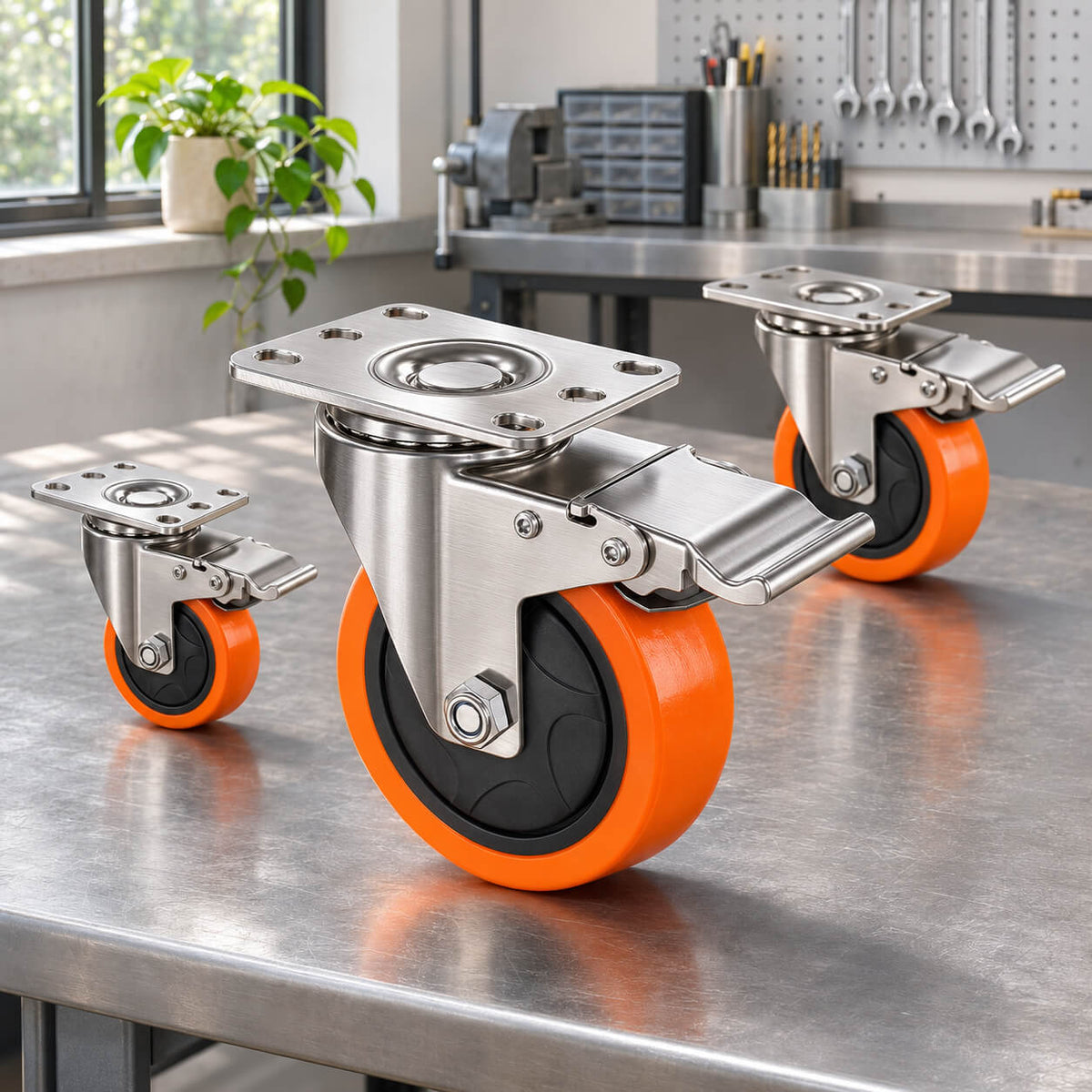
These top-plate swivel casters have:
- A 304 stainless steel bracket
- An orange PP wheel tread with a black core
- A foot-operated total-lock brake
- Four casters per set
| Wheel diameter | Rated capacity per set of 4 |
|---|---|
| 2 in. | 700 lb |
| 3 in. | 1,200 lb |
| 4 in. | 1,800 lb |
The listed capacities are for a set of four. Before ordering, compare the selected size’s mounting dimensions, load height, wheel material, and capacity with your equipment and working conditions.
Frequently Asked Questions
Do 304 stainless steel casters corrode?
304 stainless steel offers corrosion resistance, but it can still corrode under unsuitable conditions. Salt, certain chemicals, standing water, and the condition of the surface can affect its performance.
Can zinc-plated casters be used in damp areas?
It depends on the coating, the amount and duration of moisture exposure, and the product’s specifications. For regular moisture exposure, compare the available options and confirm suitability with the manufacturer.
Are 304 stainless steel casters always stronger?
No. Load capacity depends on the complete caster design, including its wheel, bracket, axle, and mounting construction. Compare the rated capacity of the exact caster rather than choosing by bracket material alone.
Is the entire HOLKIE caster made from stainless steel?
No. The bracket is made from 304 stainless steel. The wheel has an orange PP tread and a black core. Check the product specifications for the complete caster configuration.
Can I replace zinc-plated casters with stainless steel casters?
Possibly, if the replacement casters meet the application’s requirements. Compare the load rating, mounting plate size, hole spacing, load height, wheel material, and brake function before ordering.

3 Inch vs. 4 Inch Heavy-Duty Casters: Which Plate Caster Set Should You Choose?