

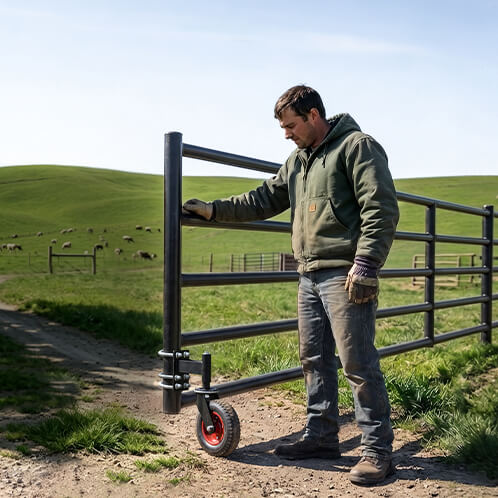
A gate wheel can make a heavy gate easier to open, help reduce dragging, and relieve some of the load placed on gate hinges. But when it is time to replace an existing wheel, one question comes up often: should you choose a pneumatic tire or a solid rubber tire?
The answer depends on the gate, the ground surface, and how much maintenance you are willing to accept. This guide explains the key differences so you can choose a compatible gate support wheel with more confidence.
What Is a Pneumatic Gate Wheel?
A pneumatic gate wheel uses an air-filled tire. Like a bicycle or utility-cart tire, it provides cushioning because the tire contains air.
Pneumatic wheels can be useful on very rough ground, but they require periodic inflation and can be vulnerable to punctures, leaks, or pressure loss. If the tire goes flat, the gate may begin to drag or lose support.
What Is a Solid Rubber Gate Wheel?
A solid rubber gate wheel uses a non-inflatable tire. There is no air chamber to inflate, leak, or puncture.
For homeowners, farms, and commercial properties that want less maintenance, a solid rubber tire can be a practical flat-free alternative. It is especially useful when a gate wheel needs dependable day-to-day support without tire-pressure checks.
Solid Rubber vs. Pneumatic Gate Wheels
| Feature | Solid Rubber Gate Wheel | Pneumatic Gate Wheel |
|---|---|---|
| Inflation required | No | Yes |
| Flat or puncture risk | No air-related flats | Can lose air or puncture |
| Routine maintenance | Low | Tire pressure should be checked |
| Cushioning | Provided mainly by the gate wheel's spring system | Provided by tire air pressure |
| Best for | Low-maintenance gate support | Users who prefer an air-filled tire |
The best choice is not always the same for every gate. Before replacing a wheel, confirm that the new wheel fits the gate frame, provides enough ground clearance, and supports the required load.
When a Solid Rubber Gate Wheel Is a Good Replacement Choice
A solid rubber gate wheel may be a good option when:
- Your previous pneumatic wheel needs frequent inflation.
- You want a flat-free tire for daily gate use.
- Your gate travels over grass, gravel, dirt, concrete, or a mixed outdoor surface.
- You need a wheel that helps support a heavy gate and reduce dragging.
- Your gate has enough clearance for the wheel diameter and mounting bracket.
- The existing mounting position is compatible with the replacement wheel.
A solid rubber wheel is not automatically a universal replacement. Always check the mounting dimensions, gate frame material, gate clearance, and load requirement before ordering.
Why a Spring-Loaded Gate Wheel Matters
The tire is only one part of a gate support system. On uneven driveways or sloped ground, a fixed-height wheel may lose contact with the ground or place extra stress on the gate.
A spring-loaded gate wheel helps respond to minor changes in ground level as the gate opens and closes. The spring absorbs movement and helps the wheel continue supporting the gate, which can reduce dragging and hinge stress.
For heavy gates, this combination can be especially useful:
- Solid rubber tire for flat-free rolling
- Swivel wheel for following the gate's movement
- Enclosed spring for height adjustment and shock absorption
- Heavy-duty bracket for gate-frame support
Featured Option: 8 in Spring-Loaded Solid Rubber Gate Wheel
Our 8 in Heavy-Duty Spring-Loaded Gate Wheel is designed as a flat-free gate support solution for compatible wood and metal gates.
Key specifications:
- 8 in solid rubber tire
- 750 lb load capacity per wheel
- Spring-loaded swivel design
- Approximately 1-7/8 in spring travel
- Hardware for wood gates and metal tube or pipe gates
- No inflation required
It is suitable for many driveway gates, farm gates, ranch gates, fence gates, and other compatible outdoor gate applications.
Shop the 8 in Spring-Loaded Gate Wheel
Before You Replace Your Gate Wheel
Use this quick checklist before choosing a replacement:
- Measure the available mounting area on the gate.
- Confirm that the wheel diameter provides sufficient clearance.
- Check whether the gate frame is wood, round pipe, square tube, or another material.
- Confirm that the wheel's load capacity meets the gate's support needs.
- Verify that the hardware is compatible with your gate frame.
- Consider the surface the gate will roll across most often.

Frequently Asked Questions
Is a solid rubber gate wheel pneumatic?
No. A solid rubber gate wheel is non-pneumatic, meaning it does not use an air-filled tire and does not require inflation.
Can a solid rubber gate wheel replace a pneumatic gate wheel?
It can replace a compatible pneumatic gate wheel if the mounting dimensions, gate clearance, frame type, and load requirements match. Always confirm fitment before purchase.
Will a solid rubber tire go flat?
A solid rubber tire does not rely on air, so it will not go flat from air loss or punctures.
Is a spring-loaded gate wheel useful on uneven ground?
A spring-loaded wheel can help the gate maintain support across minor changes in surface height. It is designed to help reduce dragging and relieve stress on gate hinges.
Choose the Gate Wheel That Fits Your Gate
A pneumatic wheel may suit customers who specifically want an air-filled tire. A solid rubber gate wheel is a better fit for customers who want a flat-free, lower-maintenance alternative.
For compatible heavy gates, an 8 in spring-loaded solid rubber gate wheel offers dependable support, no-inflation convenience, and smoother rolling across common outdoor surfaces.
Shop the 8 in Heavy-Duty Spring-Loaded Gate Wheel




Leveling Casters vs. Retractable Casters: Which Is Right for Your Equipment?
Total Lock vs. Wheel Brake: Which Heavy-Duty Caster Lock Do You Need?