
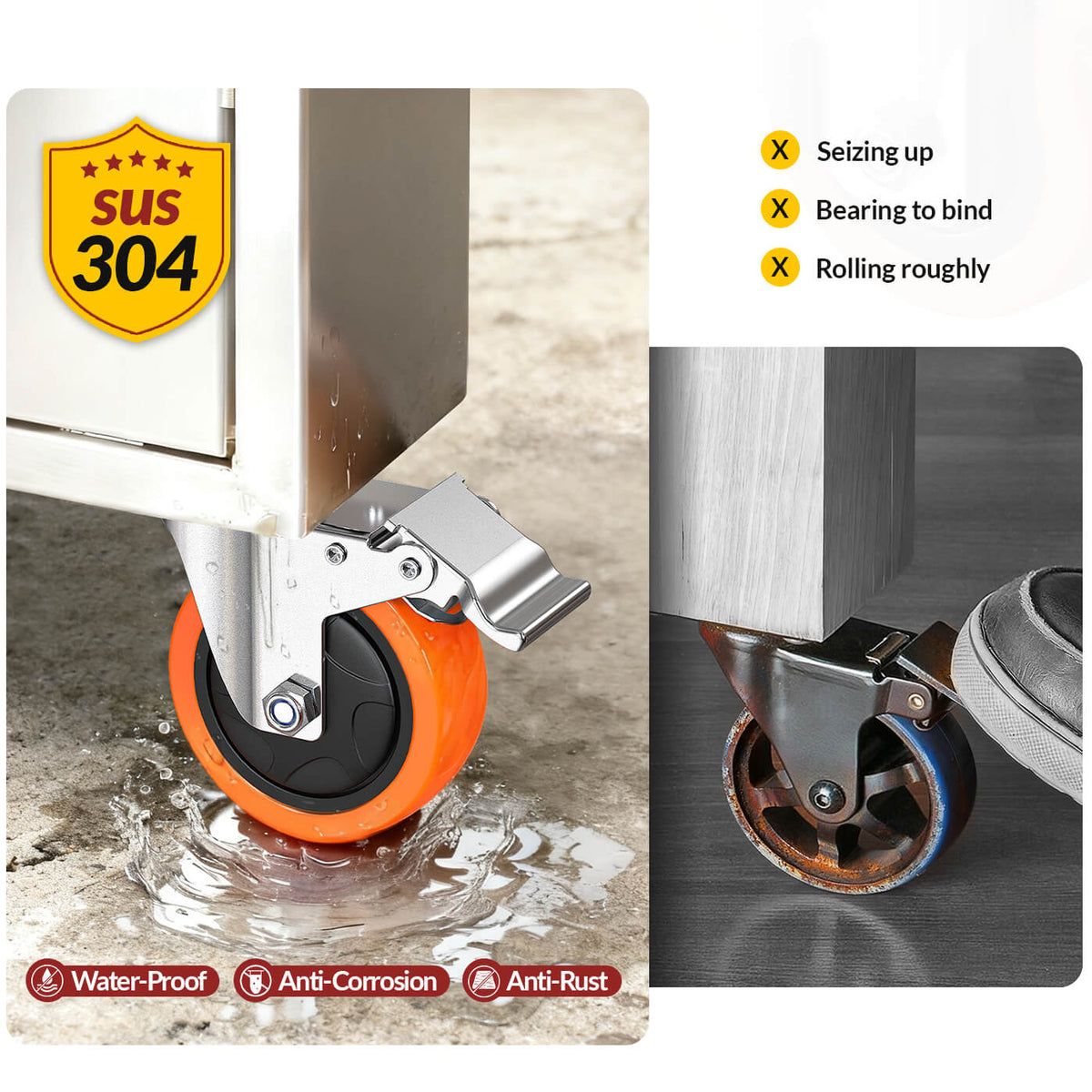
Stainless steel casters are caster wheels designed with stainless steel components, usually including the mounting plate, swivel bracket, or fork. They are commonly selected for equipment that needs mobility, corrosion resistance, and reliable positioning in demanding environments.
However, not every part of a stainless steel caster is necessarily made from stainless steel. A complete caster may combine a stainless steel bracket with a polymer wheel, such as PP, TPR, or polyurethane. Understanding the materials and design is important when choosing casters for workbenches, carts, tables, laboratory equipment, and mobile storage units.
What Makes a Caster a Stainless Steel Caster?
The most important part to check is the material of the bracket and mounting plate. These components support the equipment and are exposed to moisture, cleaning, impact, and repeated movement.
HOLKIE stainless steel casters feature:
-
A 304 stainless steel mounting bracket
-
An orange PP wheel tread
-
A black wheel core
-
A top-plate mounting design
-
A swivel function for directional movement
-
A total-lock pedal brake
The 304 stainless steel bracket provides strong corrosion resistance in humid and frequently cleaned environments. The PP wheel tread provides a durable rolling surface for many indoor and covered outdoor applications.
Stainless steel does not mean the caster is completely unaffected by every environment. Continuous exposure to salt, standing water, or aggressive chemicals may still require additional material and maintenance considerations.
What Are the Benefits of Stainless Steel Casters?
1. Corrosion Resistance
304 stainless steel is widely used where moisture and regular cleaning are concerns. Compared with ordinary carbon steel, it offers better resistance to corrosion and surface deterioration in many common environments.
This makes stainless steel casters useful for:
-
Workshops
-
Commercial carts
-
Laboratory equipment
-
Storage tables
-
Food-service equipment
-
Mobile workbenches
-
Frequently cleaned work areas
The exact suitability depends on the environment, cleaning chemicals, temperature, and exposure conditions.
2. Stable Positioning with a Total-Lock Brake
A total-lock caster locks both the wheel and the swivel mechanism. When the brake is engaged, the caster cannot roll or pivot freely.
This is useful when a cart, table, or workbench needs to remain stable during loading, unloading, assembly, or regular use.
A wheel-only brake stops rolling but may still allow the caster to swivel. A total-lock pedal brake provides control over both movement functions.
3. Multiple Wheel Sizes and Load Capacities
Stainless steel casters are available in different wheel diameters to meet different clearance and load requirements.
HOLKIE total-lock plate casters are available in three sizes:
| Wheel Diameter | Overall Height | Capacity per Set of 4 |
|---|---|---|
| 2 in. / 50 mm | 2.83 in. / 71.78 mm | 700 lb |
| 3 in. / 75 mm | 4.20 in. / 106.68 mm | 1,200 lb |
| 4 in. / 100 mm | 5.16 in. / 131.18 mm | 1,800 lb |
These capacities are for a set of four casters with an evenly distributed load. They should not be interpreted as the capacity of one caster.
Actual performance may vary according to floor condition, mounting strength, impact, uneven loading, and operating environment.
How to Choose Stainless Steel Casters
Check the Mounting Style
Stainless steel casters are available with different mounting methods, including top plates, threaded stems, grip-ring stems, and bolt holes.
Top-plate casters are commonly used for:
-
Workbenches
-
Carts
-
Tables
-
Cabinets
-
Equipment stands
-
Mobile storage units
Before ordering, compare the caster’s plate dimensions, hole spacing, hole size, and overall height with your equipment.
Choose the Correct Wheel Diameter
A larger wheel does not automatically fit every application.
Choose a 2 inch caster when you need:
-
Lower overall height
-
A compact installation
-
A smaller wheel footprint
Choose a 3 inch or 4 inch caster when you need:
-
More load capacity
-
Greater ground clearance
-
A larger wheel for heavier equipment
Make sure the selected wheel size provides enough clearance for the frame, brake pedal, and surrounding components.
Calculate the Required Load Capacity
To estimate the required caster capacity, divide the total equipment load by three instead of four. This provides a margin for uneven floors or uneven load distribution.
For example, if the equipment and contents weigh 900 lb:
900 lb ÷ 3 = 300 lb minimum capacity per caster
The final selection should also consider impact, movement frequency, flooring, and whether the equipment will be pushed over thresholds or uneven surfaces.
Consider the Brake Function
Choose a total-lock caster when the equipment needs to stay in position and resist both rolling and swiveling.
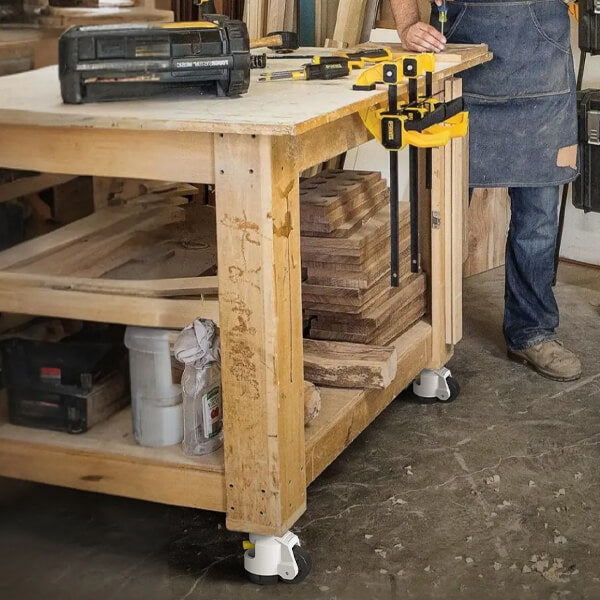
A total-lock caster is especially useful for workbenches, carts, tables, and equipment that may be loaded or operated while stationary.
Match the Wheel Material to the Floor
The wheel tread material affects rolling behavior, durability, noise, and floor interaction.
HOLKIE stainless steel casters use an orange PP tread with a black wheel core. PP wheels are suitable for many hard, smooth surfaces and general-purpose equipment applications.
For delicate floors, uneven surfaces, high-temperature areas, or chemically aggressive environments, review the wheel material specifications carefully before ordering.
Where Are Stainless Steel Casters Used?
Stainless steel casters are commonly used on equipment that needs both mobility and resistance to moisture or frequent cleaning.
Typical applications include:
-
Stainless steel workbenches
-
Laboratory carts
-
Commercial prep tables
-
Tool carts
-
Utility carts
-
Mobile storage equipment
-
Equipment stands
-
Retail fixtures
-
Cabinets and furniture
-
Workshop tables
For healthcare, food-service, or laboratory applications, the caster should be evaluated together with the complete equipment design and the specific requirements of the facility.
How to Maintain Stainless Steel Casters
Regular maintenance can help extend caster service life.
-
Remove dust, debris, and material buildup from the wheel.
-
Keep the mounting hardware properly tightened.
-
Check that the brake engages and releases correctly.
-
Inspect the wheel tread for cracks, flat spots, or excessive wear.
-
Clean stainless steel surfaces with a suitable mild cleaner.
-
Avoid leaving the caster in standing water or corrosive residue.
-
Check the mounting plate after moving heavily loaded equipment.
Do not use harsh cleaning chemicals unless they are confirmed to be compatible with 304 stainless steel and the wheel material.
Final Buying Checklist
Before purchasing stainless steel casters, confirm:
-
Bracket and mounting plate material
-
Wheel tread material
-
Wheel diameter and width
-
Overall installation height
-
Mounting plate dimensions
-
Hole size and hole spacing
-
Brake type
-
Load capacity per set
-
Quantity included
-
Suitability for the working environment
For equipment that requires a corrosion-resistant bracket, top-plate mounting, and control over both rolling and swiveling, see HOLKIE’s 304 stainless steel total-lock plate casters.
Frequently Asked Questions
Are stainless steel casters completely rustproof?
No caster should automatically be described as rustproof. 304 stainless steel offers strong corrosion resistance, but prolonged exposure to salt, standing water, or aggressive chemicals may still cause corrosion or surface damage.
Are the wheels also made from stainless steel?
Not necessarily. HOLKIE casters use a 304 stainless steel bracket with an orange PP wheel tread and black wheel core.
What is the difference between a locking caster and a total-lock caster?
A standard locking caster may stop the wheel from rolling. A total-lock caster locks both the wheel and the swivel mechanism.
Are stainless steel casters suitable for outdoor use?
They can be suitable for many indoor and covered outdoor applications. For permanent outdoor exposure, consider moisture, salt, temperature changes, drainage, and cleaning conditions before selecting the caster.
How many casters are included?
The HOLKIE product is sold as a set of four casters. Load capacity varies by wheel diameter and is specified per set of four.



Are Leveling Casters Self-Leveling? How Adjustable Leveling Casters Work