
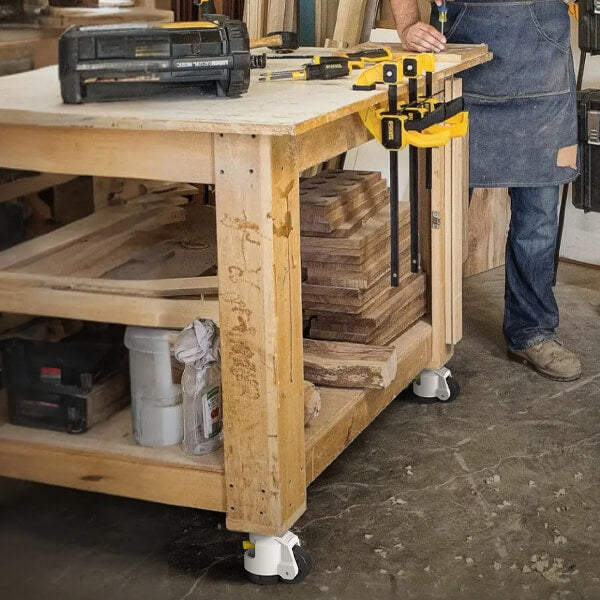
Choose plate mount leveling casters when your equipment has a flat, reinforced mounting surface with a compatible bolt-hole pattern. Choose threaded stem leveling casters when it has a correctly sized threaded socket, insert, or through-hole that can safely support the caster and working load.
The right choice depends on the equipment frame and mounting connection, not on which style appears stronger.
Quick Answer: Plate Mount or Threaded Stem?
| If your equipment has... | The usual starting point is... |
|---|---|
| A flat steel or wood base with room for several bolts | Plate mount leveling casters |
| A welded nut, threaded insert, or threaded leg socket | Threaded stem leveling casters |
| A thin or unsupported frame | Reinforce the frame before selecting either mounting style |
| An existing caster pattern you need to replace | Match the exact plate dimensions or stem thread before ordering |
| An uncertain mounting condition | Measure the frame and request an application review before purchase |
Both mounting styles can work for workbenches, machine stands, equipment tables, and industrial frames. The important question is whether the frame and connection are properly designed for the load.
Browse Holkie leveling casters after confirming your mounting style, loaded weight, installed height, and required leveling range.
What Is a Plate Mount Leveling Caster?
A plate mount leveling caster attaches through a mounting plate and multiple bolts. The plate distributes the connection over a defined area of the equipment frame.
Plate mount leveling casters are commonly used when:
-
The equipment has a flat mounting surface.
-
The frame can accept a bolt pattern.
-
The installer can access the bolts, nuts, or both.
-
Several fasteners are preferred for the connection.
-
A replacement caster needs to match an existing plate pattern.
Before ordering, measure the plate length and width, mounting-hole diameter, hole spacing, frame thickness, and clearance for the wheel and leveling mechanism.

What Is a Threaded Stem Leveling Caster?
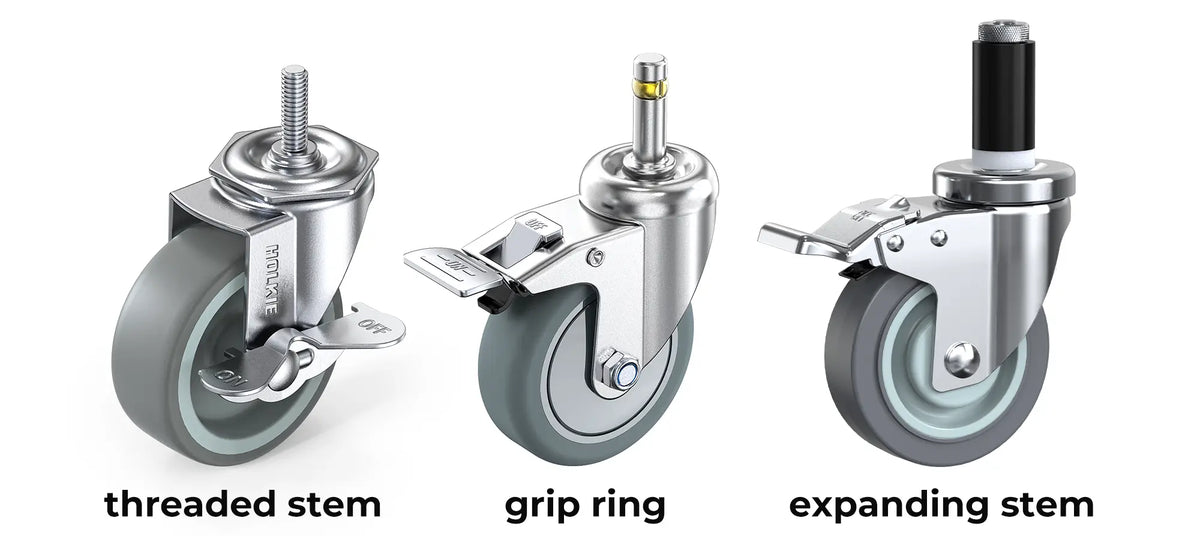
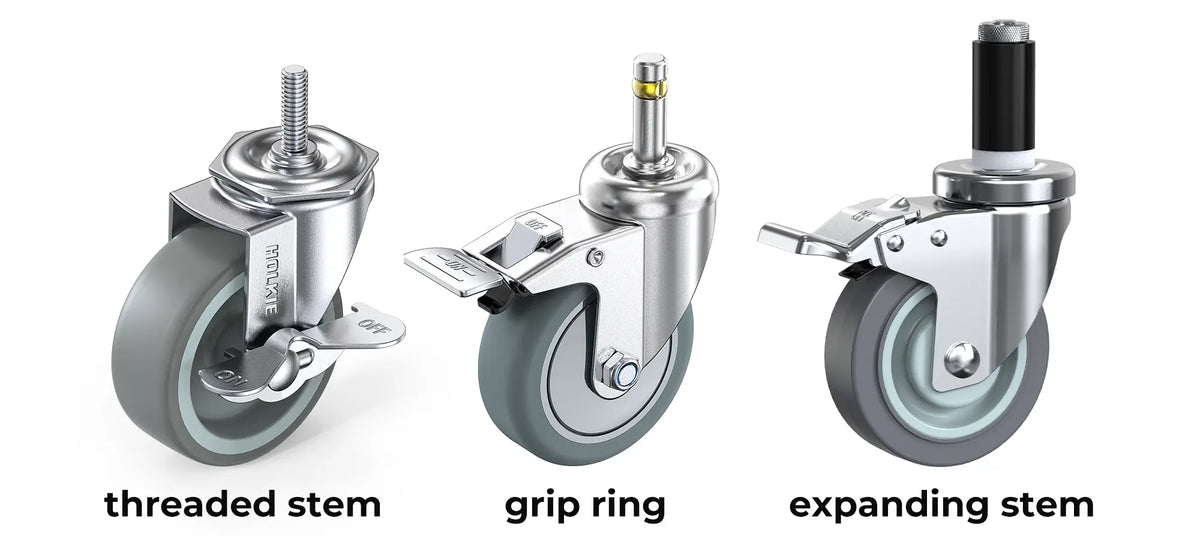
A threaded stem leveling caster attaches through one threaded stem rather than a multi-bolt plate. The stem may screw into a threaded socket, welded nut, threaded insert, or through-hole with suitable hardware.
Threaded stem leveling casters are commonly used when:
-
Equipment already uses threaded legs or caster sockets.
-
The mounting point is compact.
-
The design does not have room for a mounting plate.
-
The installer needs an adjustable connection.
-
A workbench or machine stand was designed around a specific stem thread.
The thread must match exactly. “M12” alone is not enough: confirm thread pitch, usable stem length, available engagement depth, hardware type, and clearance for the leveling mechanism.

Plate Mount vs. Threaded Stem: Main Differences
| Factor | Plate mount | Threaded stem |
| Connection | Multiple bolts through a mounting plate | One threaded stem with matching hardware |
| Space needed | Flat area for the plate and fasteners | Compatible threaded location and stem clearance |
| Replacement check | Plate size, hole size, and hole spacing | Thread diameter, pitch, length, and engagement |
| Installation access | Access for bolts, nuts, or both | Access to tighten and secure the stem or nut |
| Frame requirement | Surface strong enough for the bolt pattern | Thread, insert, or frame connection designed for the load |
| Common mistake | Matching plate size but ignoring hole spacing | Matching diameter but ignoring thread pitch or engagement |
Neither style is automatically better for every load. The mounting system is only as reliable as the equipment frame, fasteners, threads, and installation.
How to Choose the Right Mounting Style
Choose plate mount leveling casters when the frame supports a bolt pattern
Plate mount is often a practical starting point for welded steel workbenches, shop tables, and equipment bases with a flat reinforced mounting area. It can also simplify replacement when the existing caster already provides a plate pattern to measure.
Check these points:
-
Does the available flat area fully support the mounting plate?
-
Do the hole spacing and hole diameters match the selected model?
-
Is the frame thick and reinforced enough for the fasteners and working load?
-
Can you tighten the hardware without interference from drawers, cross-braces, or components?
-
Will the installed caster leave enough clearance for the wheel and leveling foot to operate?
Choose threaded stem leveling casters when the equipment has a compatible thread
Threaded stem models are useful when equipment already has threaded legs or dedicated caster sockets. They use less mounting area, but require exact thread compatibility and sufficient engagement.
Check these points:
-
What is the exact thread diameter and pitch?
-
How much usable threaded engagement is available?
-
Does the frame use a welded nut, insert, tapped hole, or through-hole?
-
Is the mounting point designed to carry the fully loaded equipment?
-
Can the stem be secured with the required nut, washer, or locking method?
Do not force a near-match thread. A stem that seems to fit but has the wrong pitch can damage the mounting point and create an unsafe connection.
Measurement Checklist Before Ordering
For plate mount leveling casters
-
Available mounting surface length and width
-
Existing plate length and width, if replacing a caster
-
Mounting-hole diameter
-
Center-to-center hole spacing in both directions
-
Frame thickness and material
-
Clearance above and beside the mounting location
-
Final equipment height after installation
For threaded stem leveling casters
-
Thread diameter
-
Thread pitch
-
Usable thread depth or stem engagement
-
Required stem length outside the frame
-
Insert, welded nut, or through-hole detail
-
Clearance around the stem and adjustment mechanism
-
Final equipment height after installation
For an application review, a photo with a ruler, a measured sketch, and the loaded equipment weight are more useful than a product name alone.
Do Not Choose by Capacity Alone
Capacity matters, but it does not prove mounting compatibility. A leveling caster may have an appropriate stated rating and still be unsuitable when:
-
The plate does not fit the frame.
-
The threaded stem does not match the socket.
-
The equipment frame lacks reinforcement.
-
The installed height creates an unsuitable working height.
-
The leveling range cannot compensate for the floor condition.
-
Capacity is misunderstood as per caster instead of per set, or the reverse.
Use the fully loaded working weight, including tools, fixtures, stored materials, and the heaviest normal workpiece. Then confirm how the selected product page states capacity before ordering.
Common Installation Problems
Plate holes do not line up
Do not elongate holes or drill into a frame without confirming the change will not weaken the equipment. Select a compatible plate, use an approved adapter design, or request an engineering review.
The threaded stem turns but will not tighten
Stop and check the thread pitch, thread condition, and engagement depth. The issue may be a mismatched thread, damaged insert, or a stem that bottoms out before it is secured.
The equipment rocks after installation
Confirm that all casters are mounted evenly, the leveling feet are adjusted in the final working position, and the frame is not twisting under load. For the setup process, read How to Level a Workbench With Leveling Casters.
The equipment height changed more than expected
Compare the current leg or caster height with the selected caster's complete installed height. Include the height added when the leveling foot is deployed, not only wheel diameter.
Frequently Asked Questions
Are plate mount leveling casters stronger than threaded stem leveling casters?
Not automatically. A plate mount uses multiple fasteners, while a threaded stem depends on the thread and mounting point. Frame design, hardware, engagement, and installation determine whether the connection is appropriate.
How do I measure a threaded caster stem?
Measure the thread diameter and pitch, then the usable stem length and available thread engagement in the equipment. Confirm these values against the current product specification before purchase.
Can I replace a threaded stem caster with a plate mount caster?
Only when the frame can safely accept a plate and bolt pattern. This conversion may require reinforcement or a redesigned mounting surface.
Can I replace a plate mount caster with a threaded stem caster?
Only when the equipment has a correctly sized, load-capable threaded mounting point. Do not rely on a single improvised hole in a thin frame.
What should I send for a bulk or OEM inquiry?
Send the loaded equipment weight, number of casters, mounting dimensions, photos or a drawing of the frame, desired installed height, floor condition, movement frequency, quantity, and delivery destination.
Choose the Correct Leveling Caster Mount
Use a plate mount when equipment has a compatible, reinforced bolt-on surface. Use a threaded stem when it has the exact thread and engagement required for the selected model.
Compare current Holkie leveling caster options against your measurements before ordering. For multi-unit, OEM, or custom mounting requirements, submit the application details through Holkie's Bulk Order page.




Are Stem Casters Universal? How to Identify the Right Stem Size
How to Select Machine Leveling Casters for Industrial Equipment