

Leveling casters and retractable casters both help equipment move and become stable, but they solve different problems. Choose leveling casters when you need adjustable feet to stabilize a workbench or equipment frame. Choose retractable casters when you need a lifting or lowering mechanism to change between a mobile position and a supported position.
Quick Comparison
| Selection factor | Leveling casters | Retractable casters |
|---|---|---|
| Primary function | Adjust the leveling feet to stabilize equipment | Raise, lower, or retract the support mechanism |
| Best for | Workbenches, equipment tables, machine frames, and stable workstations | Mobile workstations that need frequent transitions between moving and supported positions |
| Stability method | The leveling feet provide the working support after adjustment | The lifting/lowering mechanism changes how the equipment contacts the floor |
| Typical setup | Move the equipment, then adjust the feet | Operate the mechanism to change between mobile and supported states |
| Main selection concern | Mounting, load, adjustment range, and floor contact | Mechanism clearance, operating access, load, and movement frequency |
The correct choice depends on how the equipment is used after it reaches its working position. A caster that rolls well is not automatically the best caster for a workbench that must remain stable during use.
What Are Leveling Casters?
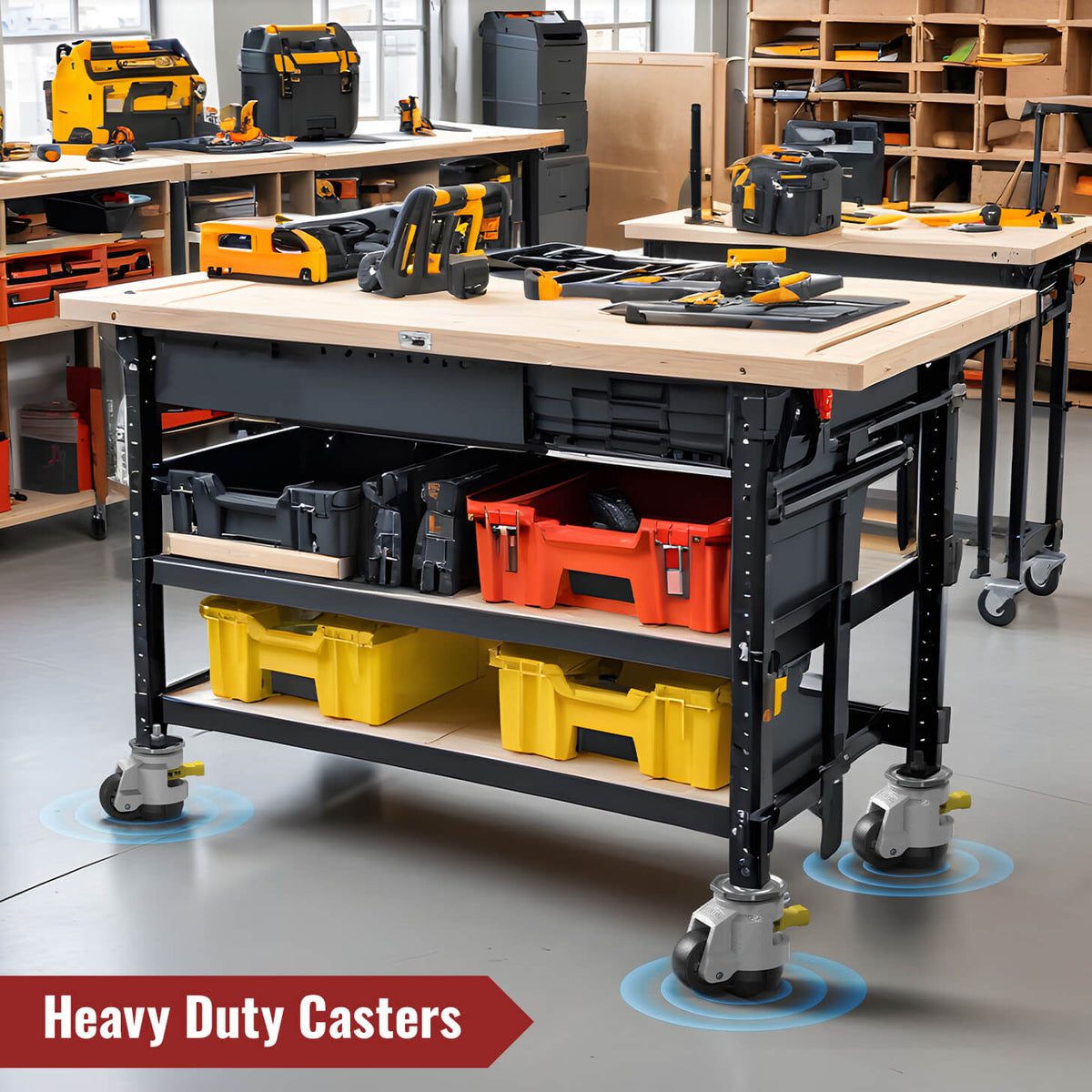
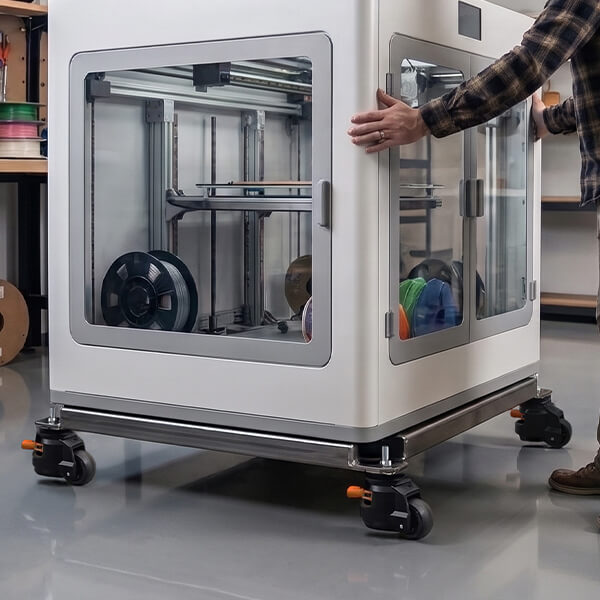
Leveling casters combine a wheel with an adjustable leveling foot. The wheel allows a workbench or equipment frame to be repositioned. After the equipment is moved, the leveling foot is adjusted so the frame is supported and no longer rocks on small floor differences.
Choose leveling casters when your application needs:
- a stable workbench after positioning;
- adjustable height or floor compensation within the model's range;
- a plate-mount or threaded-stem installation;
- occasional movement rather than constant repositioning;
- a clear separation between rolling and working support.
Leveling casters are not a substitute for engineered anchoring when equipment requires permanent restraint, seismic protection, or a site-specific safety system.
What Are Retractable Casters?
Retractable casters use a lifting, lowering, or retracting mechanism to change the equipment between a mobile position and a supported position. The mechanism is operated by pedal. Always confirm the operation method and required clearance on the product page.
Choose retractable casters when your application needs:
- repeated changes between moving and working positions;
- a quick transition without manually adjusting each leveling foot;
- a lifting or lowering action as part of the equipment workflow;
- mechanism access from the side, front, or another specified direction;
- a mobile workstation that is repositioned regularly.
Retractable casters are not simply leveling casters with a different name. The mechanism, installation space, operating clearance, and support behavior must match the equipment design.
Leveling Casters or Retractable Casters: Which Should You Choose?
Choose leveling casters when stability is the main requirement
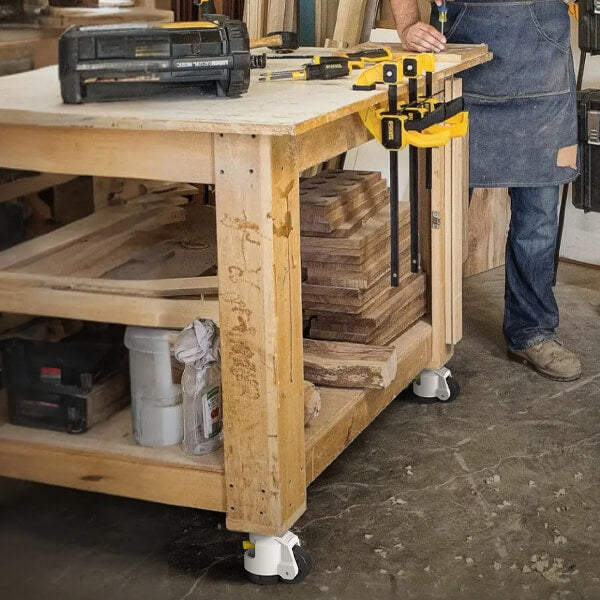
Leveling casters are usually the better fit for a workbench, shop table, or equipment frame that is moved into position and then used as a stable workstation. They are also a practical choice when the installer can adjust each caster during setup and does not need a frequent lifting or lowering cycle.
Before ordering, confirm:
- the total loaded weight of the equipment;
- the plate-hole pattern or threaded-stem size;
- the required overall height;
- the leveling adjustment range;
- the wheel material and floor condition.
Choose retractable casters when movement is part of the workflow
Retractable casters are more suitable when operators regularly move the equipment, then activate a mechanism to lower or raise the support. This can be useful for mobile workstations, equipment carts, and other units that must alternate between repositioning and working.
Before ordering, confirm:
- how often the mechanism will be operated;
- whether the operator can reach the pedal;
- the clearance needed for the mechanism;
- the loaded capacity of the selected model;
- whether the equipment frame is strong enough for the mounting points.

Leveling Casters vs. Retractable Leveling Casters
The phrase “retractable leveling casters” can describe different product designs. Some products use a wheel and a leveling foot. Others use a lifting/lowering mechanism that changes the support position. Do not select a product based on the phrase alone.
Ask these questions:
- Does the product use a manually adjusted leveling foot?
- Does the mechanism lift or lower the equipment?
- Does the equipment need a fixed working height?
- Can the operator reach the adjustment point safely?
- Is the stated capacity for one caster or a set?
If the product page does not answer these questions, request the mounting drawing and application recommendation before placing a project order.

Can You Use Leveling and Retractable Casters Together?
Do not combine unrelated caster types simply to add more stability. The mounting height, support points, load distribution, and operating sequence must be designed together. In most applications, it is better to choose one mechanism that matches the equipment's intended workflow.
If a project requires a special combination, provide the equipment drawing, total loaded weight, mounting locations, floor condition, and movement requirements through Holkie's Bulk Order page.
How to Compare the Product Specifications
Use the same checklist for both product types:
| Specification | Why it matters |
|---|---|
| Load capacity | Prevents selecting a product that is undersized for the loaded equipment |
| Capacity basis | Confirms whether the rating applies per caster or per set |
| Mounting style | Determines whether the frame can accept the product |
| Overall height | Controls the final work-surface height and clearance |
| Leveling or lift range | Determines how much floor difference or support movement can be addressed |
| Wheel material and diameter | Affects floor compatibility, rolling effort, and clearance |
| Operating access | Confirms the handle, pedal, or adjustment point can be used safely |
| Movement frequency | Separates an occasional-move application from a repeated-move workflow |
Never compare only the advertised load number. A model with a higher rating can still be wrong if its mounting pattern, height, mechanism clearance, or support range does not fit the equipment.
Common Selection Mistakes
Mistake 1: Treating “locking” and “leveling” as the same function
A wheel lock can restrict wheel rotation or swivel. A leveling foot is intended to support and stabilize equipment after positioning. They are not interchangeable functions.
Mistake 2: Choosing retractable casters because they sound faster
Retractable mechanisms need suitable clearance, access, and structural support. If the equipment is moved only during installation or occasional reconfiguration, leveling casters may be the simpler solution.
Mistake 3: Dividing the empty equipment weight by the number of wheels
Use the fully loaded working weight and follow the selected model's rating method. Include tools, fixtures, stored materials, and the heaviest normal workpiece.
Mistake 4: Ignoring the working position
The right product must keep the equipment stable in the position where it is used, not only make it easy to roll across the floor.
Frequently Asked Questions
Are leveling casters and retractable casters the same?
No. Leveling casters use adjustable feet to stabilize equipment. Retractable casters use a lifting, lowering, or retracting mechanism to change the support position.
Are retractable leveling casters good for workbenches?
They can be suitable when the workbench is moved and supported repeatedly. Confirm the mechanism, working height, operating access, and loaded capacity before choosing a model.
Which is better for a heavy workbench?
The better choice depends on the workbench workflow. Leveling casters suit a bench that is positioned and then stabilized. Retractable casters suit a bench that frequently changes between moving and supported positions.
Do leveling casters lift the equipment?
Some models adjust a leveling foot, while other caster designs use a dedicated lifting or lowering mechanism. Confirm the selected model's stated function instead of assuming all leveling casters lift equipment.
Can I replace locking casters with leveling casters?
Only after checking mounting dimensions, overall height, load capacity, floor contact, and the required working stability. A wheel lock and a leveling foot do not provide the same support behavior.
How do I choose between plate-mount and threaded-stem options?
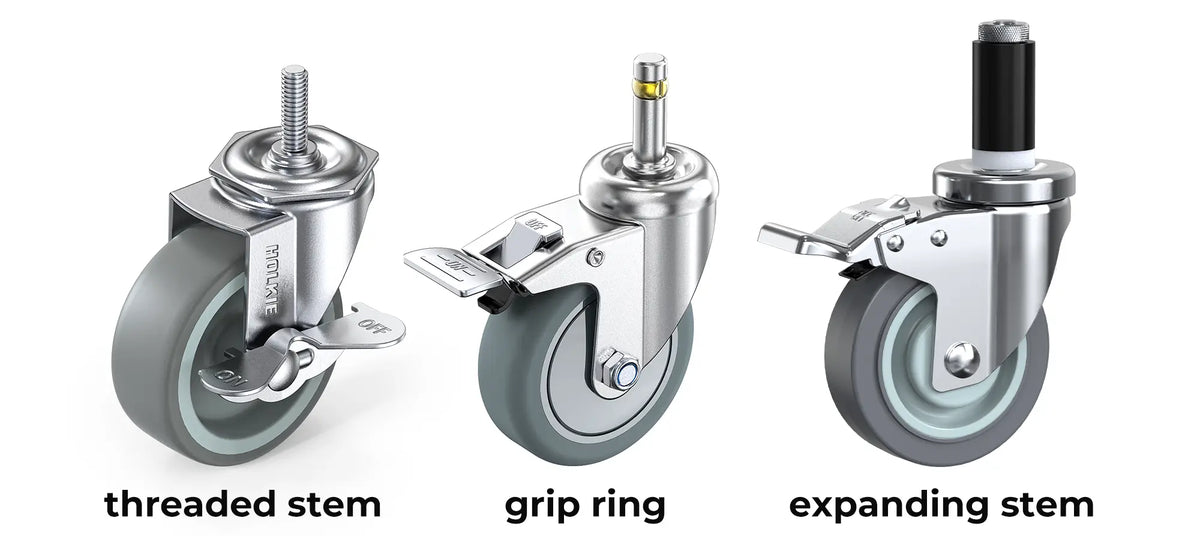
Match the caster to the equipment frame. Plate-mount products need a compatible plate and bolt-hole pattern. Threaded-stem products need the correct thread, engagement, nut, and frame clearance.
What information should I provide for a bulk order?
Provide the equipment drawing, total loaded weight, number of casters, mounting details, desired height, floor type, movement frequency, quantity, and destination. This allows the product team to evaluate the application rather than recommend a product from weight alone.
Final Recommendation
Use leveling casters when you need mobility followed by adjustable, stable support. Use retractable casters when your equipment needs a repeatable lifting, lowering, or retracting action as part of its normal workflow.
Compare Holkie leveling casters and retractable casters by function, mounting, height, capacity basis, and operating access. For custom dimensions or volume requirements, contact Holkie through the Bulk Order page.



Solid Rubber vs. Pneumatic Gate Wheels: How to Choose a Flat-Free Replacement